
The problem
Industrial epoxy systems have documented service-life ranges — proactive maintenance and scheduled recoating extends asset life.
Our approach
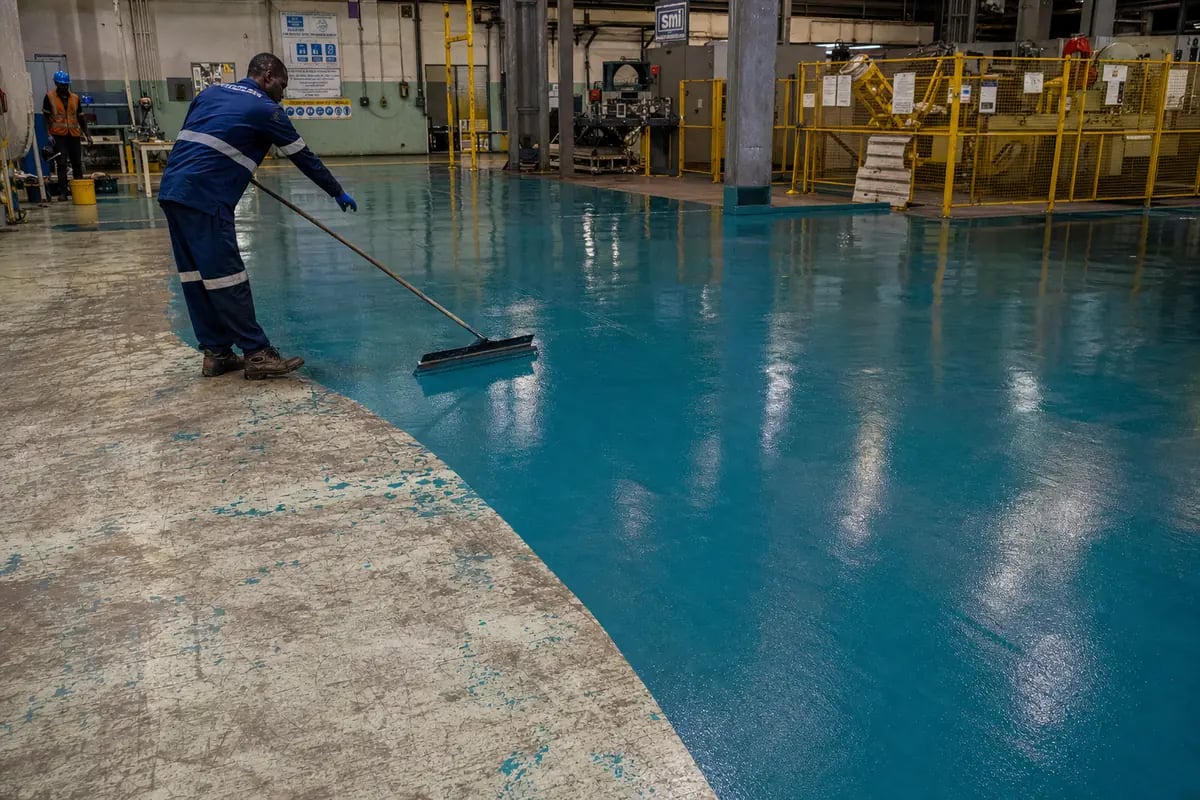
Epoxy GH operates a maintenance-and-recoating programme — annual inspection, surface refresh, lifecycle-aligned recoating.
Epoxy GH operates a maintenance-and-recoating programme — annual inspection, surface refresh, lifecycle-aligned recoating.
The Challenge
Epoxy flooring systems installed to specification-grade standards do not fail overnight. They degrade incrementally — through thermal cycling, chemical exposure, wheeled-traffic abrasion, and the slow ingress of moisture at inadequately sealed joints. Facilities management teams operating across multiple properties frequently encounter the same pattern: a system that performed at commissioning begins to show micro-crazing, adhesion loss at perimeters, or topcoat chalking within three to seven years of installation. Without a structured maintenance programme, that degradation accelerates, and what could have been a scheduled surface refresh becomes a full-system strip-and-relay.
The institutional cost of unplanned flooring failure is rarely limited to the flooring itself. Operational disruption, compliance exposure in pharmaceutical or food-processing environments, and the reputational cost to hospitality and corporate clients of a floor that no longer reads as premium — these compound the capital outlay. Across healthcare facilities, logistics hubs, manufacturing floors, and Tier-1 commercial lobbies throughout Accra and the broader coastal industrial belt, the absence of lifecycle-aligned recoating schedules is the single most common reason specification-grade systems are replaced before their engineered lifespan is exhausted.
Clients managing multi-property portfolios face a further layer of complexity: coordinating inspection intervals, surface condition grading, and recoating windows across disparate sites, each with its own operational calendar. Without an institutional-grade maintenance partner, that coordination defaults to reactive crisis management.
The Epoxy GH Solution
Epoxy GH operates a structured Maintenance and Recoating Programme designed for facilities managers and property directors who require lifecycle certainty, not reactive patching. The programme is anchored by an annual technical inspection — conducted by specialist applicators with decades of field practice — during which every floor zone is assessed against a five-point condition matrix: adhesion integrity, topcoat film thickness, chemical resistance retention, joint condition, and surface skid-resistance rating.
Where surface refresh is indicated, Epoxy GH deploys a preparation-first methodology: mechanical diamond grinding to remove oxidised or contaminated topcoat layers, followed by controlled primer reactivation and system-matched recoating using the same formulation class as the original installation wherever possible. For systems approaching their engineered recoating threshold, a full lifecycle-aligned recoating schedule is proposed — sequencing recoating windows against the client’s operational calendar to eliminate unplanned downtime.
All materials specified within the programme are sourced from the same Tier-1 industrial formulation supply chain used in Epoxy GH’s new-install operations, ensuring colour-batch consistency, chemical resistance parity, and warranty continuity across the maintenance lifecycle.
Material and System Specification
- High-build epoxy topcoat (100–300 micron DFT) — system-matched recoating for chemical and abrasion-resistant zones
- Moisture-tolerant epoxy primer — reactivation layer applied post-grinding to restore intercoat adhesion
- Polyurethane wear coat — specified for high-footfall commercial lobbies and hospitality reception floors requiring gloss retention
- Polyurea joint filler — fast-cure joint reseal for industrial and logistics floors subject to wheeled-vehicle trafficking
- Anti-slip broadcast aggregate — re-broadcast to specification where skid-resistance ratings have degraded below compliance threshold
- Condition assessment report — issued in writing after each annual inspection, with zone-by-zone grading and recoating timeline recommendations
Typical Project Profile
The Maintenance and Recoating Programme is structured for clients holding between two and twenty properties under a single facilities management mandate. Typical engagements span healthcare and clinical facilities, food and beverage processing plants in the Tema industrial corridor, corporate and institutional interiors in Accra CBD and Airport City, and logistics distribution centres operating under food-safety or cold-chain compliance frameworks. Annual inspection visits are coordinated to minimise operational disruption, with recoating windows typically scheduled across two to five working nights per floor zone.
Outcomes
- Extended system lifespan — lifecycle-aligned recoating typically adds eight to fifteen years beyond the unaided system lifespan
- Reduced total cost of ownership — structured maintenance consistently outperforms reactive strip-and-relay on a per-square-metre lifecycle basis
- Compliance continuity — skid-resistance and chemical-resistance ratings maintained within regulatory and sector-standard thresholds
- Operational certainty — pre-scheduled recoating windows eliminate unplanned production or hospitality disruption
- Single-programme accountability — one specialist partner holds inspection records, material specifications, and recoating history across all portfolio properties