
The problem
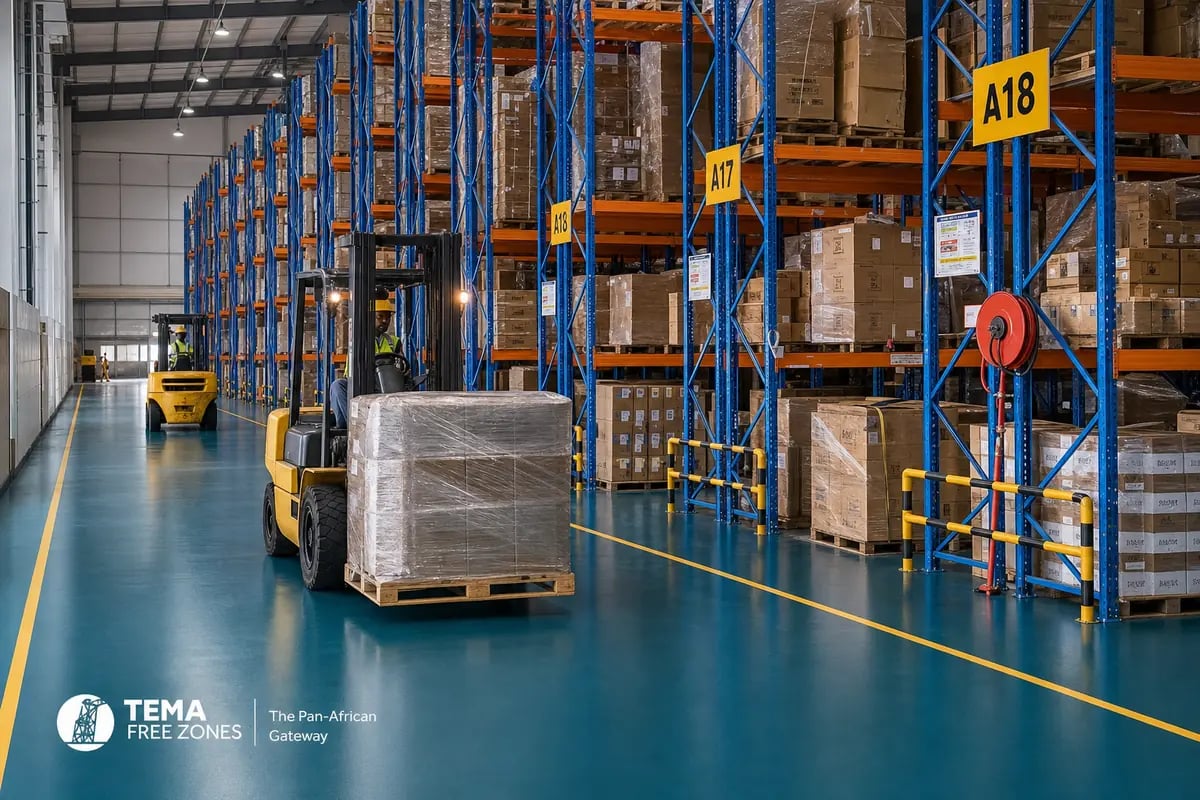
Port-adjacent warehouses face sustained 10-tonne forklift traffic plus chemical exposure — conventional flooring fails within months without specification-grade engineering.
Our approach
Epoxy GH installs heavy-load epoxy systems with polyurethane topcoat over FF50+ self-levelling substrate — engineered for 10-tonne forklift loads and 10+ year service life.
Epoxy GH installs heavy-load epoxy systems with polyurethane topcoat over FF50+ self-levelling substrate — engineered for 10-tonne forklift loads and 10+ year service life.
The Challenge
Logistics and warehousing facilities in Ghana’s industrial corridor operate under mechanical stress that standard floor treatments cannot sustain. Forklifts rated at 10 tonnes or more traverse the same slab lines daily, concentrated loads compress point pressures to extremes, and the thermal cycling of a corrugated-roof warehouse in the harmattan months introduces dimensional movement that brittle coatings cannot absorb. Within eighteen months, a conventionally sealed concrete floor will exhibit craze-cracking, delamination at construction joints, and surface contamination from hydraulic fluid ingress — all of which escalate from cosmetic defects into operational safety events.
The sector compounds this pressure further. High-throughput distribution centres and bonded warehouses operate on continuous shift patterns, leaving no maintenance window long enough for remedial patchwork. A floor specification chosen at fit-out must therefore be right from day one — engineered to resist abrasion, chemical spill, and impact loading across a service horizon measured in decades, not in annual maintenance cycles.
Specification-grade logistics facilities require a flooring system assembled from the substrate upward: flatness tolerance that prevents pallet-rack lean, a structural layer capable of distributing concentrated loads, and a topcoat that resists the traffic chemistry of a working warehouse without degrading into a slip or contamination hazard.
The Epoxy GH Solution
Epoxy GH installs a composite heavy-load system anchored in a self-levelling epoxy substrate poured to FF50 or better — a flatness tolerance that satisfies the most exacting racking and automated guided vehicle (AGV) requirements. The self-levelling pour eliminates the feathered-edge irregularities that thin-coat systems leave behind, providing the structural continuity that distributes forklift wheel loads across a broader slab area and reduces localised stress concentration at the surface interface.
Over this substrate, a polyurethane topcoat is applied to a controlled wet-film thickness. Polyurethane outperforms conventional epoxy finishes in impact resilience and UV stability — critical for facilities with open loading bays where sunlight exposure and forklift tyre chemistry interact at the threshold zone. The result is a surface that retains its finish register through years of operational loading rather than chalking or yellowing in the first wet season.
The system is detailed at construction joints, column bases, and perimeter upstands using flexible joint compounds and coved skirting profiles specified to prevent moisture infiltration and hydraulic fluid migration beneath the body coat — the failure path most common in under-specified industrial floors.
Material + System Specification
- Substrate: FF50+ self-levelling epoxy — minimum 3 mm nominal thickness
- Body coat: High-build solvent-free epoxy, 2-component, 300–500 µm DFT
- Topcoat: Aliphatic polyurethane, impact- and UV-resistant, 80–120 µm DFT
- Joint treatment: Flexible polyurethane sealant at construction and isolation joints
- Finish: Anti-slip aggregate broadcast (optional, to client’s traction specification)
- Design load: Rated to 10-tonne forklift wheel load; service life target 10+ years
Typical Project Profile
A standard heavy-load logistics installation ranges from 2,000 m² to 15,000 m², encompassing main warehouse bays, dispatch marshalling lanes, and covered loading dock aprons. Programme duration runs 7 to 14 working days depending on slab moisture readings, ambient relative humidity, and the number of shift-based installation phases required to maintain partial facility operation. Sectors served include bonded logistics warehouses, pharmaceutical cold-chain distribution centres, FMCG regional distribution hubs, and industrial parts warehouses operating automated racking systems along Ghana’s Tema–Accra industrial corridor.
Outcomes
- Slab flatness achieved to FF50 or better, supporting narrow-aisle racking and AGV deployment without secondary grinding
- Zero delamination performance across the 10-year service horizon when substrate preparation and moisture testing protocols are observed
- Hydraulic fluid, battery acid, and cleaning chemical resistance maintained throughout the polyurethane topcoat service life
- Reduced long-term maintenance spend compared to conventional paint or thin-coat systems, which require annual recoating cycles
- Operational continuity preserved through phased installation programming — bay-by-bay sequencing keeps live warehouse zones productive during works