
Le problème
Pharmaceutical manufacturing under ISO 14644 cleanroom classification requires epoxy systems with documented particle generation rates and ESD compliance where validation demands.
Notre approche
Epoxy GH delivers ISO 14644 Class 5-8 compliant epoxy systems with multi-coat application discipline and IEC 61340-5-1 ESD integration.
Epoxy GH delivers ISO 14644 Class 5-8 compliant epoxy systems with multi-coat application discipline and IEC 61340-5-1 ESD integration.
The Challenge
Pharmaceutical manufacturing, medical device assembly, and advanced electronics production share an uncompromising demand: the floor must not contribute contamination. In ISO 14644 Class 5 through Class 8 controlled environments, every surface is a variable in the contamination equation. Conventional flooring systems — whether unsealed concrete, vinyl tile, or standard paint — shed particulates under foot traffic, chemical exposure, and mechanical load, introducing risks that regulatory auditors and quality assurance teams cannot accept.
The sector stakes are significant. A pharmaceutical facility operating under Ghana Food and Drugs Authority licensing, or supplying to international markets under EU GMP or WHO GMP frameworks, must demonstrate that its built environment supports — rather than undermines — its quality system. The floor, across hundreds of square metres of production and packing areas, is a primary compliance surface. Specification failure here carries consequences measurable in batch rejections, regulatory warnings, and production shutdowns.
ESD integration adds a second dimension of technical rigour. Electronics assembly, semiconductor handling, and certain pharmaceutical packaging operations require electrostatic discharge control at the floor surface level to protect both product integrity and personnel safety. IEC 61340-5-1 establishes the international benchmark for this requirement, demanding measured electrical resistance values — not approximations — documented and maintained across the service life of the installation.
The Epoxy GH Solution
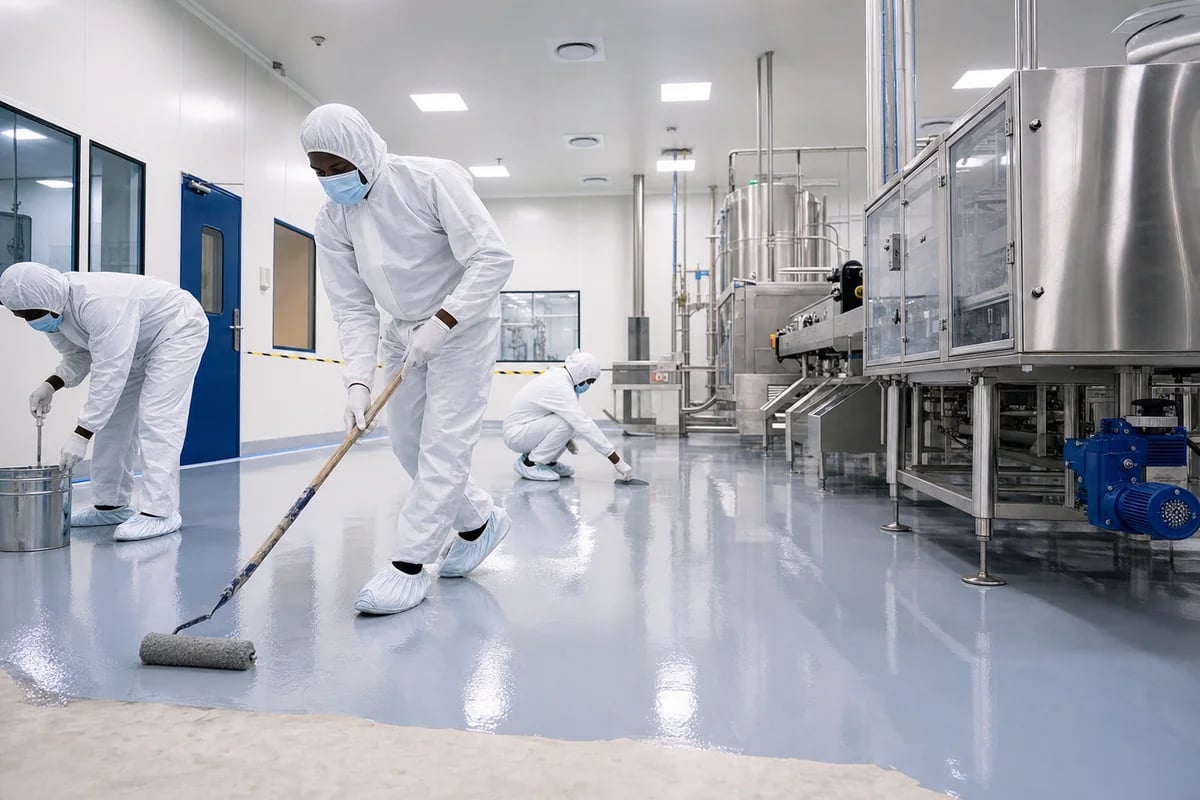
Epoxy GH applies a multi-coat system discipline refined over 45 years of practice in Ghana’s most demanding industrial and institutional facilities. For cleanroom and controlled-environment applications, the approach begins with substrate assessment and preparation to SSPC-SP standards — because no coating system performs beyond the integrity of the surface beneath it. Moisture vapour transmission, surface profile, and existing contamination are each addressed before the first coat is applied.
The coating build follows a structured sequence: primer coat for substrate penetration and bond, intermediate build coat for system thickness and chemical resistance, and a topcoat selected specifically for cleanroom duty — low-particulate emission, seamless, and chemically resistant to the cleaning agents and disinfectants standard in pharmaceutical and medical environments. Where ESD control is specified, a conductive or dissipative layer is incorporated into the system stack, with copper grounding tape installed and resistance values verified to IEC 61340-5-1 tolerances before handover documentation is issued.
Material + System Specification
- Substrate preparation: Mechanical diamond grinding or shot blasting to SSPC-SP 13 / NACE No. 6; moisture content verified below 5% CM
- Primer system: Low-viscosity epoxy penetrating primer; 100 µm DFT minimum; adhesion test per ASTM D4541 before overcoat
- Build coat: Solvent-free epoxy; 500–1000 µm DFT; slump-resistant on sloped pharmaceutical drainage profiles
- ESD / conductive layer: Dissipative or conductive epoxy per IEC 61340-5-1; point-to-point resistance 1×10⁶ to 1×10⁹ Ω (dissipative) or < 1×10⁶ Ω (conductive) as specified
- Topcoat: Pharmaceutical-grade polyurethane or epoxy topcoat; seamless finish; chemical resistance to IPA, hydrogen peroxide, and standard GMP disinfectants
- Documentation package: Resistance test records, DFT readings, material batch certificates, and cleanroom re-entry timeline per installation protocol
Typical Project Profile
A representative engagement covers 800 to 4,000 square metres across production, gowning, and materials-handling zones within a pharmaceutical manufacturing facility or electronics assembly plant. Programme duration typically runs 10 to 18 working days, governed by cure schedule, inter-coat intervals, and the client’s production shutdown window. Sectors served include pharmaceutical and nutraceutical manufacturing, medical device production, advanced electronics assembly, and laboratory facilities operating under controlled-environment classifications.
Outcomes
- Documented ISO 14644 Class 5–8 floor surface compliance, audit-ready for regulatory inspection
- Verified IEC 61340-5-1 ESD performance with full resistance measurement records at handover
- Seamless, particle-shedding-free surface that withstands standard GMP cleaning and disinfection cycles
- Elimination of grout lines, tile joints, and surface voids that harbour microbial contamination
- Extended service life under industrial cleaning regimes, reducing lifecycle maintenance cost per square metre